
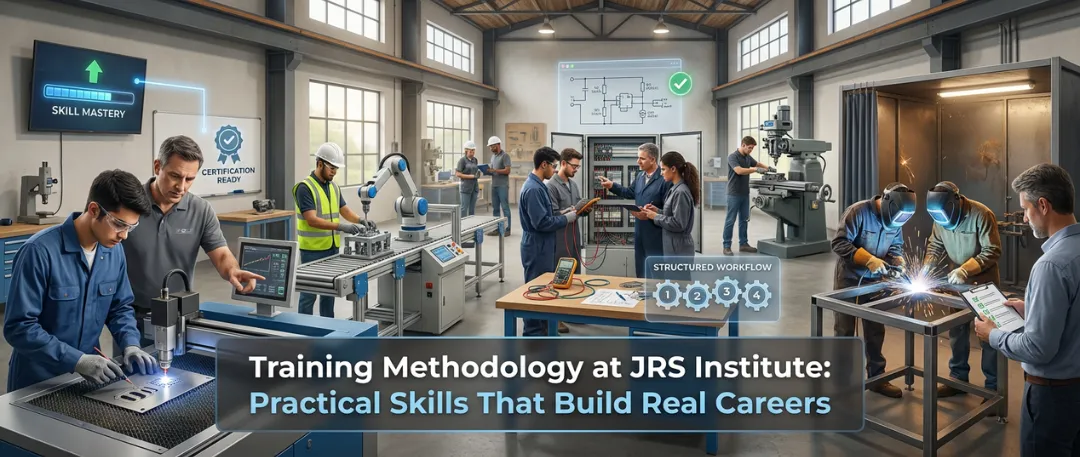
Technical training must do more than teach theory. It must prepare students to work confidently in real job environments, operate equipment, follow safety standards, and deliver professional results. This is the foundation of JRS Institute’s training methodology.
In today’s competitive workforce, employers expect technicians who can perform tasks independently from day one. JRS Institute focuses on hands-on practical learning rather than classroom theory, ensuring every student becomes job-ready in their chosen trade.
Below, we detail how the institute structures training, what students learn, and how each stage prepares them for domestic and international employment.
Practical, Workshop-Based Skill Development
The most important part of technical training is real workshop experience. JRS Institute provides practical exposure in well-equipped training spaces where students handle actual tools, materials, and machinery.
Workshops are designed to replicate job environments. Students learn by doing, not just observing.
Training includes:
- Tool and equipment handling
- Live practice sessions
- Hands-on fault finding
- Trade-specific tasks
- Testing and calibration
- Project-based training
Every student is continuously observed, corrected, and guided, ensuring they master each skill step by step.
Industry-Aligned Curriculum
Industry requirements change frequently. The institute updates training modules based on employer needs, new technologies, and global standards.
The curriculum focuses on real-world application such as:
- Construction procedures
- Electrical installations
- Industrial systems
- HVAC repair
- Welding techniques
- Maintenance procedures
This alignment ensures students learn exactly what the industry wants, improving both domestic and overseas placement opportunities.
Step-by-Step Skill Progression
Training follows a structured skill-development path. Students start with basic concepts and gradually move to advanced levels.
Skill stages include:
- Introduction to tools
- Understanding materials and components
- Safety and handling practices
- Basic operations
- Intermediate technical tasks
- Professional-level operations
- Independent work performance
This staged approach ensures every student becomes confident and capable before moving forward.
Focus on Safety Training
Safety is a major requirement in international job standards. Many industries, especially construction and industrial maintenance, demand technicians who follow safety protocols.
Students are trained in:
- PPE usage
- Equipment safety
- Electrical safety
- Fire safety
- Hazard identification
- Risk prevention
Learning correct safety procedures increases a candidate’s selection chances, especially for overseas recruitment.
Realistic Trade Tests and Assessments
Trade tests are mandatory for many jobs abroad. JRS Institute prepares students through realistic assessments that simulate actual recruitment evaluation.
Assessments include:
- Job-specific tasks
- Performance observation
- Skill accuracy
- Quality measurement
- Time-based tasks
By the time a student attends a trade test for a foreign job, they already understand what to expect.
Instructor-Led Guidance and Monitoring
Training is conducted by experienced instructors with strong industry backgrounds. Their practical experience helps students learn techniques used at real job sites.
Instructors evaluate each student’s performance and offer individual guidance wherever improvement is required.
Practical Problem Solving
Instead of just teaching procedures, students learn how to handle real problems such as:
- Equipment malfunction
- Installation errors
- Fault diagnosis
- Repair situations
- Alignment and fitting issues
This develops confidence and makes students capable of independent work.
Soft Skills and Interview Readiness
Many technically skilled workers hesitate during interviews. Therefore, JRS Institute also teaches:
- Basic communication
- Self-presentation
- Technical explanation skills
- Interview confidence
- Job understanding
These skills help students perform better during employer selection.
Hands-On Preparation for Overseas Jobs
Foreign employment requires specific technical standards. Training includes:
- International work procedures
- Tools used abroad
- Job site requirements
- Practical ability tests
- Compliance standards
This improves placement chances in Gulf and Asian countries where demand for skilled technicians is steadily increasing.
Conclusion
JRS Institute’s training methodology is designed to make students work-ready, not just course-complete. Every part of the training focuses on real technical skills, safety knowledge, and performance accuracy. With workshop-based learning, industry-aligned curriculum, and assessment-driven guidance, the institute prepares students for strong career opportunities in India and abroad.
Students leave with confidence, experience, and skills that match professional job requirements, giving them a competitive advantage in global employment markets.
FAQs
What makes the training at JRS Institute different?
It is completely practical, workshop-based, and aligned with overseas job requirements, which makes students more employable.
Is training suitable for beginners?
Yes. Training starts from basic levels and progresses step-by-step until students reach professional capability.
Do students get practical experience?
Yes, most of the training happens inside workshops with real equipment and tools.
Does training include theory?
Theory is included only to support practical understanding, not as a separate academic process.
Is job preparation included in training?
Yes. Students receive trade test preparation, interview guidance, and overseas job support.